
In Irons
Two New Jersey signers of the Declaration found out what “our Lives, our Fortunes, and our sacred Honor” actually cost.

My final piece to America 250 🇺🇸 with patriotic stories I love to research & write about, enjoy!
They put it right at the end.
After the grievances, after the vote, after the weeks of arguing.
One last line.
For the support of this Declaration, the fifty-six of them wrote:
“with a firm reliance on the protection of divine Providence, we mutually pledge to each other our Lives, our Fortunes, and our sacred Honor.”
They knew what they were promising.
The day after the vote for independence, John Adams wrote home that he was “well aware of the Toil and Blood and Treasure” it would cost to make it stick. If the war went the other way, every name on that page was a confession. Treason against the Crown, paid at the end of a rope.
The British had the names too.
And in the dark winter that followed, they came looking.
The Judge
Richard Stockton was the first New Jersey man to sign it.
A judge, a Princeton trustee, master of an estate called Morven — one of the richest and most respected men in the colony. Not a firebrand. The careful kind, with a great deal to lose.
By late November 1776, Washington’s army was in full retreat across New Jersey and the British were right on its heels. Stockton got his family out of Princeton and rode for the coast to hide them with a friend.
A local Loyalist tipped off the British that he was there.
They came in the night.
November 30th.
Hauled him out of bed, stripped him of what he had on him, and marched him to Perth Amboy to be handed over.
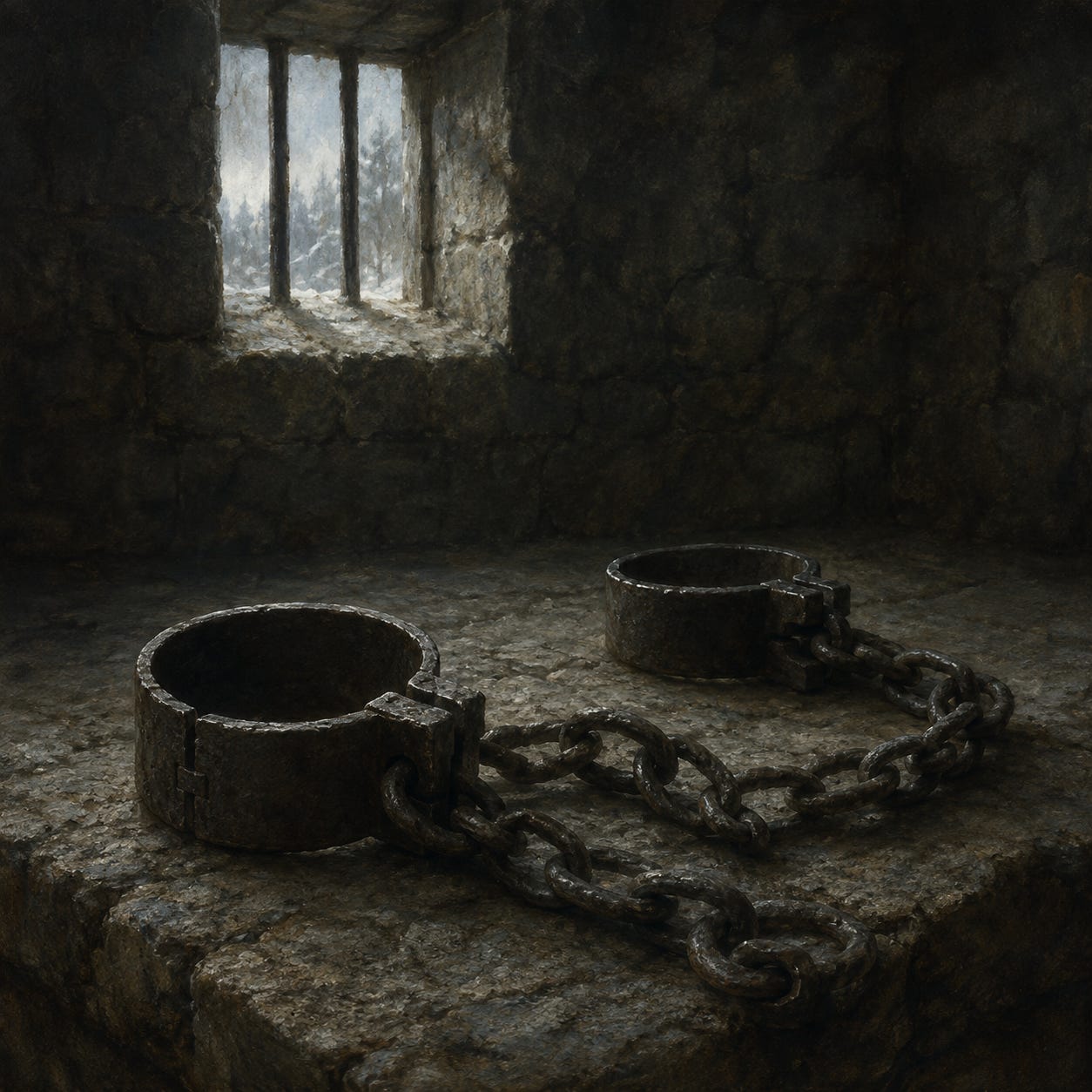
Then they put him in irons.
Of all fifty-six signers, Stockton was the only one the British clapped in chains.
The Provost
They threw him into the Provost in New York — a jail run by a notorious provost marshal, where men froze and starved by design.
By one account they started him with a full day and night without food. Stockton, soft from a comfortable life, came apart fast. His son-in-law Benjamin Rush — himself a signer — heard the judge was suffering things “from which… his being a man, ought to exempt him.”
Now the record splits, and the cheap version of this story comes apart.
The chain email that goes around every Fourth has Stockton nobly refusing a pardon and rotting in prison to the end.
That’s not what happened.
The day he was taken, the Howe brothers had issued a proclamation: swear allegiance to the King inside sixty days and get a full pardon and your property back.
Across New Jersey that winter, thousands took it. By the British count, around 4,800 men, some 2,700 of them Jerseymen.
And the evidence says Stockton, broken in that cell, was likely one of them.
Three of his own colleagues said as much at the time. Witherspoon wrote that Stockton “signed Howe’s declaration.” Hancock reported that he had “received General Howe’s protection.” A British pardon document, dug up by a Loyalist historian in our own day, lists him by name.
It isn’t airtight.
The Society of the Descendants of the Signers calls it a Tory’s rumor and points out that Howe’s own report to London claimed none of the rebel leaders had come in.
We can’t fully settle it, and honest history won’t pretend otherwise. But the weight of the evidence is that a sick, freezing, frightened man signed an oath to the King to get out — not a public recanting of the Declaration, but a bending of the knee all the same.
You won’t find that version in the Fourth of July forwards.
It’s the truer one, and it cuts closer to what “sacred Honor” really costs: not a phrase on parchment, but a choice made in the cold.
Ashes
Whatever he signed, it bought him a ruin to come home to.
While Stockton sat in the Provost, General Cornwallis had moved into Morven. By the time the judge was paroled in January, health wrecked after about five weeks inside, the estate was gutted.
Rush saw it himself:
“The whole of Mr. Stockton’s furniture, apparel, and even valuable writings have been burnt.”
The livestock driven off. His library, one of the finest in the colonies, burned to nothing. Rush put the losses at no less than five thousand pounds.
Stockton never got back up.
His health didn’t return. He reopened a small law practice when he could manage it, took students to make the rent, and died of cancer in February 1781.
The Poor Man’s Counselor
The second New Jersey man is the one history forgot, and he’s the harder act to follow.
Abraham Clark of Elizabethtown wasn’t gentry.
A surveyor who taught himself law and gave it away to farmers who couldn’t pay — they called him “the poor man’s counselor.” Plain clothes, no wig, and a standing distrust of men with money and power, including the ones on his own side.
He signed the Declaration knowing exactly what it could cost, because he already had two sons in uniform.
Aaron and Thomas Clark, both artillery officers.
Both were captured.
And both ended up in the worst place an American prisoner could land: the prison ship Jersey.
The Hell Ship
She sat in Wallabout Bay, off the Brooklyn shore — a stripped sixty-gun hulk, rudderless, her gunports sealed and replaced with little barred holes for air.
Below decks they crammed eleven hundred men into a ship built for four hundred.
Smallpox, yellow fever, dysentery, and the dark.
Every morning a guard threw back the hatch and called down the same words:
“Rebels! Turn out your dead!”
The living handed up the men who hadn’t made the night, and they were buried in the mudflats along the shore.
Over the war, the hulks in that one bay killed something like eleven thousand Americans — more than fell in all the battles of the Revolution put together.
Most of their names were never written down.
Thomas Clark was thrown into the dungeon of that ship. By the accounts that came down, he was kept alive on scraps his fellow prisoners pushed to him through the keyhole of the cell.
His health was destroyed in there.
He walked out alive and died young anyway, never the same man.
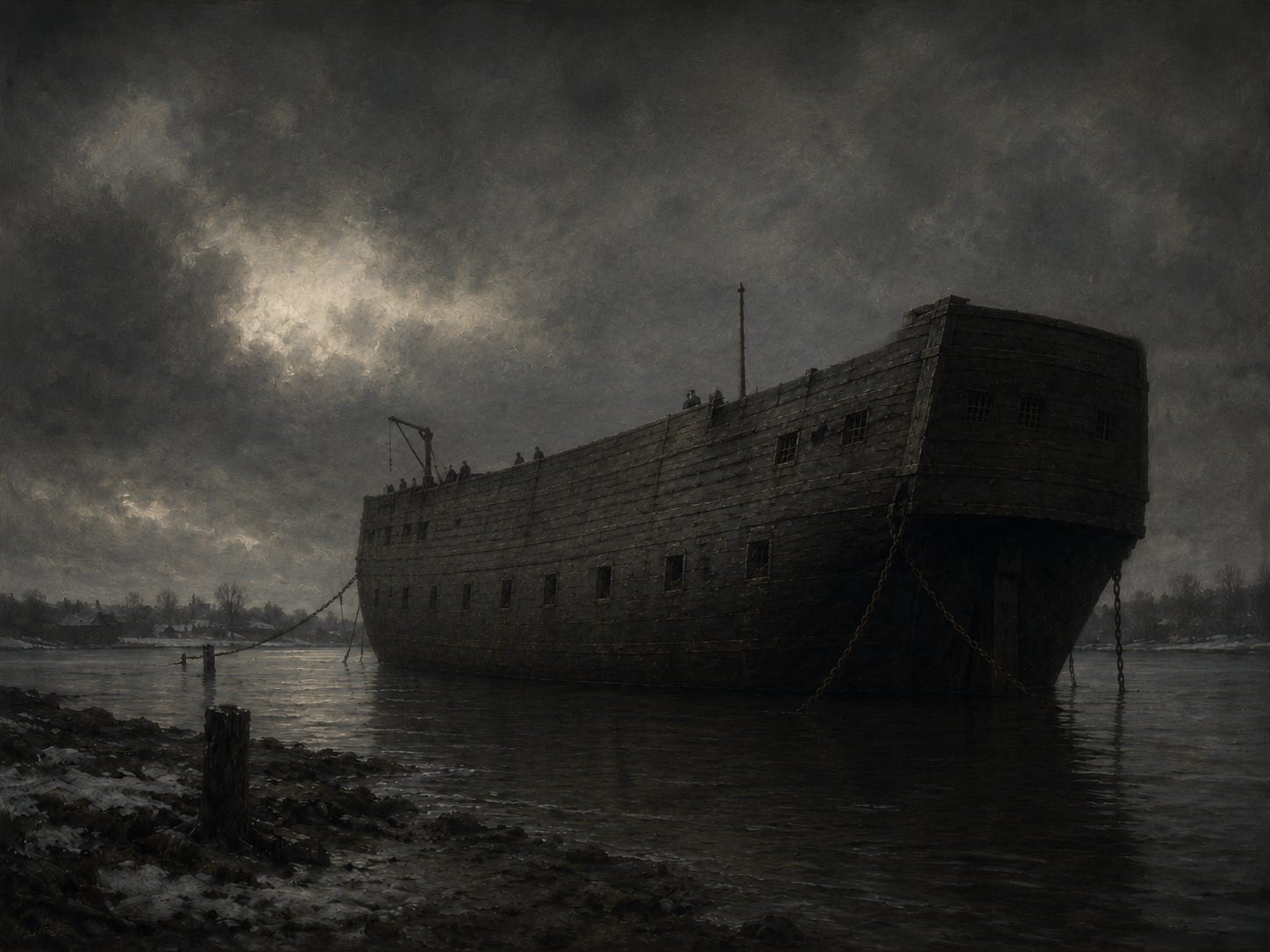
“The Jersey in Wallabout Bay — stripped to a hulk, rudderless, moored off the Brooklyn shore. More men died in her hold than fell on every battlefield of the Revolution.”
His Answer
Here’s the part about Abraham Clark that ought to be carved somewhere.
He was a sitting congressman. One word to the right people might have eased his sons’ treatment.
He refused to say it.
He would not use his seat to buy his own family a mercy the other prisoners couldn’t get. It was only when other delegates learned about Thomas in that dungeon that Congress moved — threatening to retaliate on a British officer until the boy was pulled out of the hole.
And then the story that’s come down through the signers’ own descendants: the British offered Clark a deal.
Recant, come over to the Crown, and they’d hand his sons back.
That last beat is the kind that gets polished in the retelling, so take it as what it is — an account passed down, not a line from a primary document.
But here’s what isn’t in dispute.
Clark never traded his name for his boys.
Both stayed prisoners until the general exchange at the end of the war. Whatever was or wasn’t put to him in words, the man had every earthly reason to fold, and he didn’t.
The Line at the Bottom
They weren’t being dramatic when they wrote it.
Some signers were hunted and caught — the three South Carolinians taken when Charleston fell, Stockton dragged from his bed. Some watched their homes burned and their estates wrecked. Some, like Clark, paid in their own children.
Several died before the country they declared into being was ever safe.
John Adams had signed that pledge knowing the cost. A year into the war, with things going badly, he wrote home to Abigail and put it to the future plainly:
“Posterity! You will never know, how much it cost the present Generation, to preserve your Freedom! I hope you will make a good Use of it.”
He wasn’t writing a slogan.
He was keeping a ledger.
Richard Stockton went into the ground at Stony Brook in the winter of 1781, two and a half years before the war was won.
He never saw it.
Thomas Clark walked off the Jersey alive, but the ship had taken his health for keeps, and he was dead himself before the decade was out.
By the counts that survive, more Americans died in the prison hulks of Wallabout Bay than were killed in every battle of the Revolution put together.
Of the three things those fifty-six men pledged, honor was the one they called sacred — and it turned out to be the hardest to keep.
Clark kept his, and his sons stayed aboard that ship for it.
Stockton may have bent in a freezing cell, and carried it the rest of his days.
Same pledge, same war. Two different bills, both paid in full.
There it is — a historical account many in this day and age will never grasp: the cost of freedom, and the intent of our founding fathers’ words for the greatest country on earth.
— Grounds For Truth
A Few Details Worth Keeping
Stockton’s wife is the one who should be famous. Annis Boudinot Stockton ran Morven, published poetry under her own name when few women dared, and traded letters with George Washington. As the British closed on Princeton, she buried the family silver and carried off the secret papers of the patriot Whig Society — and was later made the only woman ever admitted to it. “Though a female,” she once wrote her brother, “I was born a Patriot.”
Stockton had a lot of company that winter. The amnesty he likely took wasn’t some rare disgrace — by the British tally, roughly 4,800 people swore the Howe oath in those weeks, around 2,700 of them from New Jersey alone. The whole state was buckling in the dark after Washington’s retreat. Stockton was one frightened name among thousands.
John Hart got the rough end of the same season. The man Clark addressed as Speaker of the New Jersey Assembly had his own farm raided by Hessians and hid out in the Sourland hills before dying in 1779. The popular tale that he lost all thirteen of his children forever is false — but the raid, and the hiding, are real.
The dead finally got a marker. For more than a century, Brooklynites kept turning up bones along the Wallabout shoreline. The remains were gathered at last beneath the Prison Ship Martyrs’ Monument in Fort Greene Park — a granite column standing over a hundred feet tall, dedicated in 1908 — for men whose names were mostly never recorded.
If ya liked it and want to keep the coffee flowin’ while I keep researching and digging for the truth, you can buy me a cup here. This table stays membership-free, same as always. Thanks for pullin’ up a chair.
Until next time…

A lot of research went into this, thanks to the below sources to pull this story together —
Sources and Further Reading
Declaration of Independence, closing pledge — National Archives transcript
John Adams to Abigail Adams, July 3, 1776, “Toil and Blood and Treasure” — Founders Online
John Adams to Abigail Adams, April 26, 1777, the “Posterity!” letter — Founders Online
“The Signer Who Recanted,” American Heritage — the case that Stockton signed Howe’s oath
“Was Richard Stockton a Hero?”, Journal of the American Revolution — the dispute in full, including the British “full pardon” document found by Todd Braisted
“A Patriot Who Was Forced to Recant,” Princeton Alumni Weekly
“Who Was Richard Stockton?” Brian D. Colwell — the defense, drawing on the Society of the Descendants of the Signers and His Sacred Honor
Benjamin Rush, Autobiography and letters — on Stockton’s imprisonment and the plundering of Morven.
Abraham Clark — Descendants of the Signers of the Declaration of Independence
“‘Rebels! Turn out your dead!’: The Prison Ship Martyrs of the American Revolution,” Readex — carries the 1781 prisoner’s letter
Thomas Dring, Recollections of the Jersey Prison-Ship (1829) — a survivor’s account.
Edwin G. Burrows, Forgotten Patriots: The Untold Story of American Prisoners During the Revolution (2008).
Annis Boudinot Stockton — New Jersey Historical Society
Annis Boudinot Stockton — Mount Vernon
Witherspoon’s March 1777 letter and Hancock’s February 1777 report on Stockton are quoted within the American Heritage and Journal of the American Revolution pieces linked above.
May our Country live and be strong in the face of would be totalitarian politics.